
A practical guide for SEO specialists, link builders, content marketers, and SEO managers.
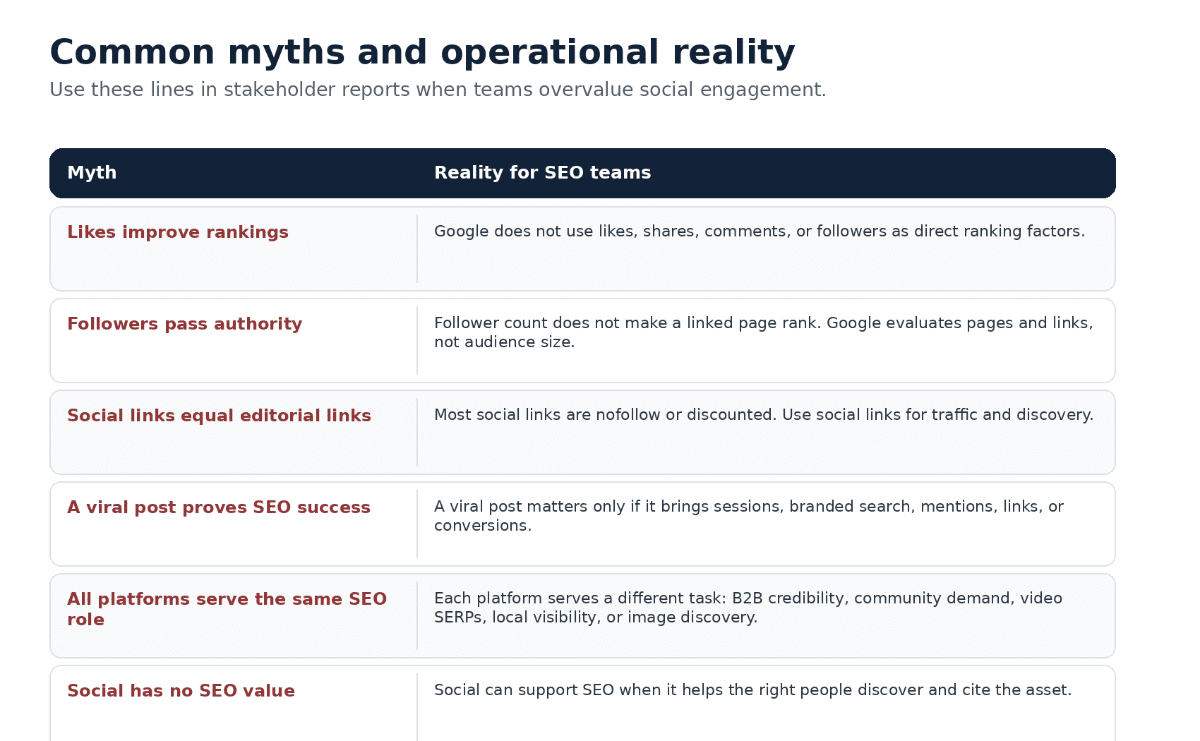
Social signals do not rank pages by themselves. Google does not count a Facebook like, a LinkedIn share, a Reddit upvote, or an X repost as a direct vote for a URL.
Social still matters for SEO. It gives useful content a path to people who can cite it: bloggers, journalists, analysts, partners, customers, and practitioners. Those people can create the signals that search engines can use: mentions, links, branded demand, and engaged traffic.
This article turns the source research into an operating model. It separates confirmed facts from industry observations and gives SEO teams a way to plan, promote, measure, and report social distribution without claiming that likes improve rankings.
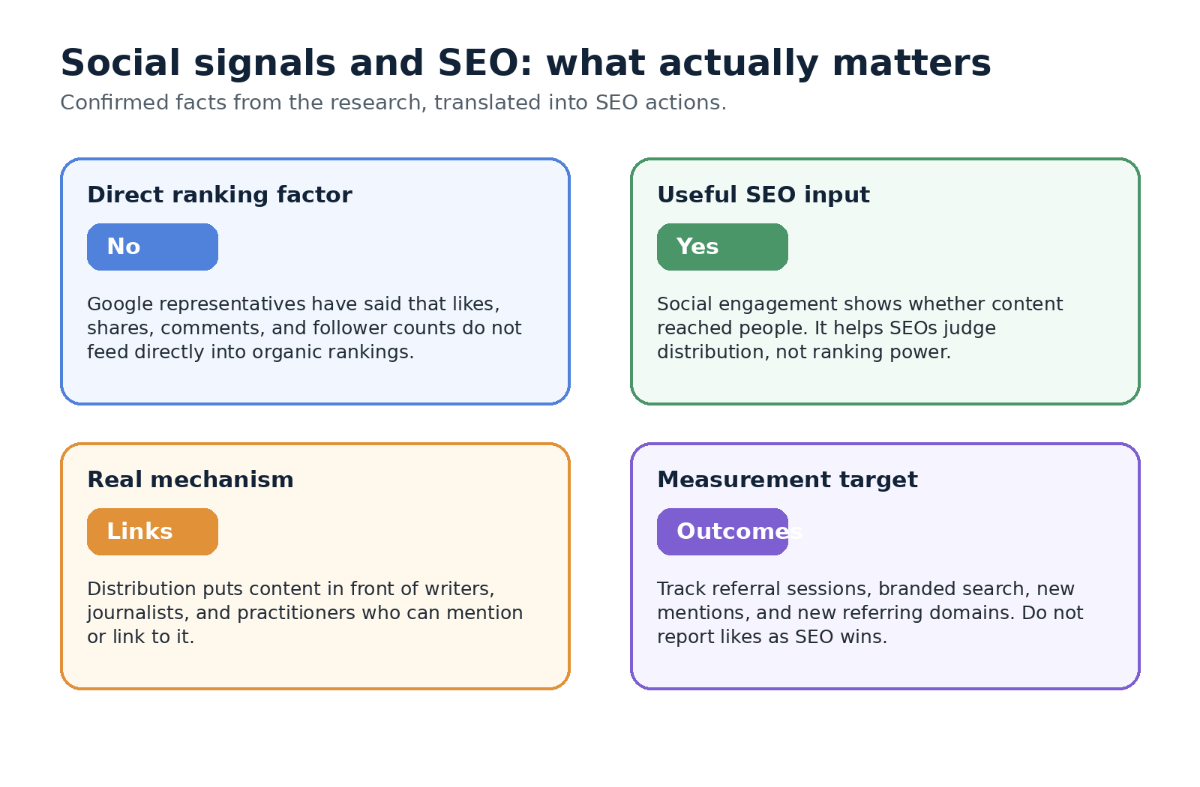
The verdict: social signals are not a direct Google ranking factor
Google representatives have said for years that social metrics do not feed directly into organic rankings. The source research cites public statements from John Mueller, Matt Cutts, and Gary Illyes. Their position stays consistent: likes, shares, comments, and follower counts do not act like PageRank.
Google can crawl public social pages when the platform allows crawling. That does not mean Google uses engagement metrics from those pages to rank the linked site. Indexing a public social post and rewarding the URL inside that post are separate actions.
Google also tested social data in the past. The clearest example came from the old Google +1 button, where Google said it would start looking at +1s as one of many signals. The later public guidance moved away from that idea. The research shows no public evidence that Google kept social votes as a stable ranking factor.
What this means in SEO work
Do not write a report that says, “LinkedIn shares improved rankings.” Write the claim only if the data shows the full chain: social distribution created referral traffic, referral traffic exposed the asset to publishers, publishers created new links or mentions, and organic performance changed after those links appeared.
Do not buy likes or follower packages for SEO. The source research explains why social metrics make poor ranking signals: platforms change access, engagement can be manipulated, and social popularity does not always match search intent.
Use social analytics as distribution diagnostics. Use GA4, Google Search Console, Ahrefs, Semrush, and brand-monitoring tools to measure outcomes.
Why social engagement often appears near strong rankings
Industry studies cited in the research found that pages with high social engagement often rank well. Searchmetrics, Moz-related analyses, Hootsuite, Ahrefs, and other industry sources have reported this relationship in different forms.
That relationship does not prove causation. A page can receive many shares because it solves a real problem, uses original data, explains a difficult topic, or gives practitioners a useful template. The same qualities can help the page earn links and satisfy search intent. Google may rank the page because of relevance, links, and usefulness, not because the page received social engagement.
This distinction matters when SEO teams report results. A social campaign can support SEO. The report must show which SEO outcome changed. Social engagement alone proves reach. It does not prove ranking impact.
Confirmed facts, observations, and hypotheses
Confirmed fact: Google representatives have said that social signals do not directly help organic rankings.
Industry observation: pages with high social engagement often also have strong search visibility. Correlation studies support this observation.
Working hypothesis: social distribution can lead to SEO gains when it creates discovery, mentions, and editorial backlinks from independent sites. SEO teams must test this chain page by page.
The real mechanism: distribution leads to discovery, mentions, and backlinks
Social media helps SEO when it expands the audience for a useful asset. The audience must include people who publish content: journalists, bloggers, newsletter authors, analysts, community moderators, educators, product reviewers, and practitioners with websites.
The process starts before the first post goes live. The content team must publish something worth citing. Generic advice rarely earns links. Original data, benchmarks, expert quotes, visual explanations, templates, calculators, teardown examples, and documented experiments give publishers a reason to cite the page.
Distribution then gives the asset reach. A LinkedIn post may put a B2B study in front of consultants and SaaS founders. A Reddit thread may expose a technical guide to practitioners. A YouTube video may occupy video search results and push branded demand. X can help time-sensitive research reach journalists and industry writers fast.
Mentions follow when people discuss the asset. Some mentions stay unlinked. Some mentions become links in newsletters, articles, resource pages, roundups, and reports. Those independent links can support rankings. This is the SEO value that the research identifies.
Social links, nofollow, UGC, and sponsored attributes
Most social links do not pass meaningful ranking value. Social platforms commonly mark outbound links as nofollow or route them through systems that search engines treat with caution. Google also gives site owners link attributes for user-generated and paid links: rel=”ugc” and rel=”sponsored”.
This changes how SEOs should evaluate social links. A link from a social profile or a post can send referral traffic. It can help users find a brand. It can help search engines discover public content. It should not sit in the same bucket as an editorial link from an independent article.
The practical rule is simple: use social links for access to people, not for link equity. The SEO goal is to convert attention into independent citations where the publisher chose to link because the asset helped the reader.
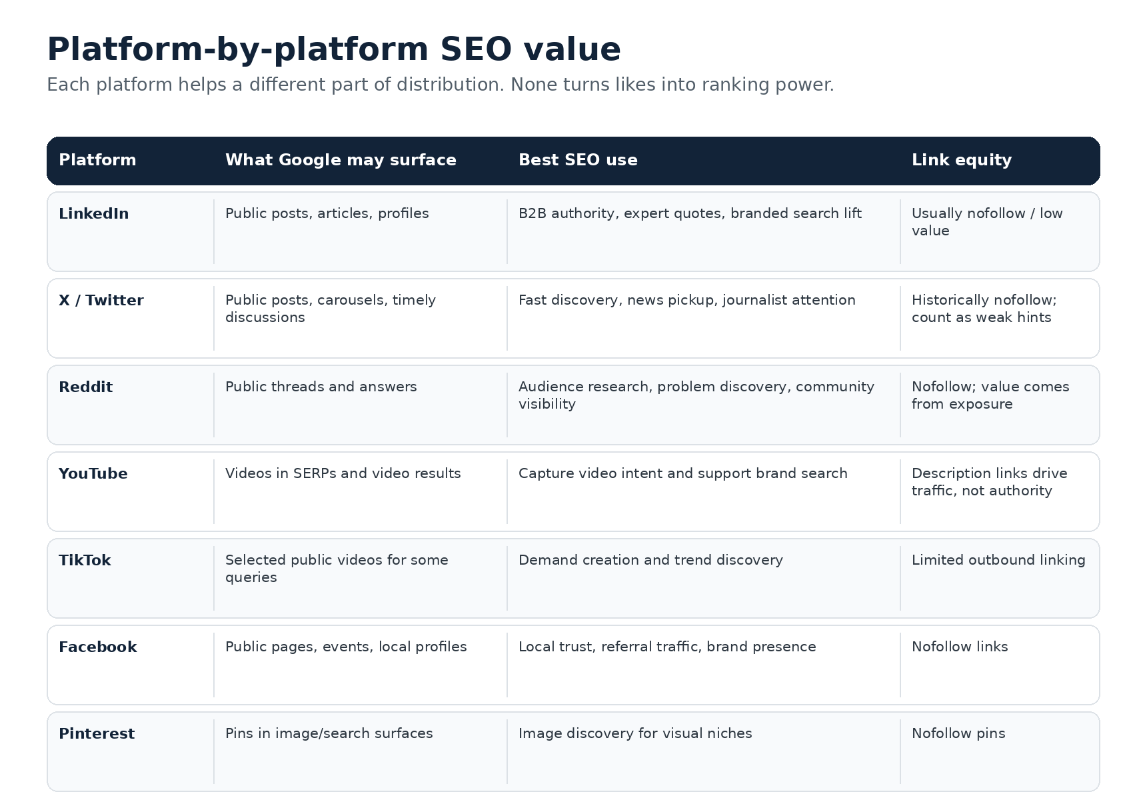
Which social platforms matter most for SEO visibility
The research shows that public social content can appear in search results when platforms allow crawling and the content matches demand. This gives social profiles and posts a role in search visibility, especially for branded queries, professional topics, community questions, and video or image results.
LinkedIn helps B2B teams reach practitioners, consultants, founders, executives, and subject-matter experts. Public LinkedIn articles and posts can appear in organic results. LinkedIn works best when a company shares expert commentary, research summaries, and practitioner evidence.
X supports speed. It helps research, commentary, and news reach journalists and industry writers. Links from X should not be treated as authority links. The value sits in pickup, conversations, and citations that happen outside the platform.
Reddit helps SEOs find real language, pain points, objections, and use cases. Google surfaces Reddit threads for many queries. Reddit links are usually not link-equity assets. Reddit can still trigger discovery when a useful answer or source earns attention in a relevant community.
YouTube matters because Google owns the video surface and often blends videos into search results. Video descriptions can drive users to a page. A strong video can also raise branded search and help a company own more SERP space.
TikTok and Pinterest work best for discovery-led categories. TikTok can create demand and shape search behavior. Pinterest can help image-led assets appear in visual discovery paths. Facebook still matters for public pages, events, local trust, and referral traffic, but closed content limits SEO value.
How social mentions turn into backlinks
A mention becomes useful for SEO when the SEO team detects it and turns it into an editorial citation. The team needs a monitoring process, not a hope that publishers will add links on their own.
Start with assets that deserve citations. A social post can amplify a weak article, but a weak article gives publishers no reason to link. The best candidates include original research, statistics pages, comparison studies, product data, templates, expert roundups, and technical explainers.
Next, build a prospecting workflow. Monitor brand mentions, asset titles, author names, quoted statistics, and key phrases from the study. When a writer mentions the asset without a link, send a short request that explains why the source link helps readers verify the claim. Teams that need to choose software for prospecting, mention tracking, outreach, and backlink checks can use a practical guide to link building tools before they standardize the process.
The request must stay factual. Do not ask for an “SEO backlink.” Ask the editor to cite the original source, add the data source, or help readers find the full method. This framing protects the relationship and keeps the link editorial.
Prioritize mentions from sites that already published the topic, have real readership, and can send qualified referral traffic. Ignore low-quality scraped mentions, spam profiles, and sites with no editorial standards.
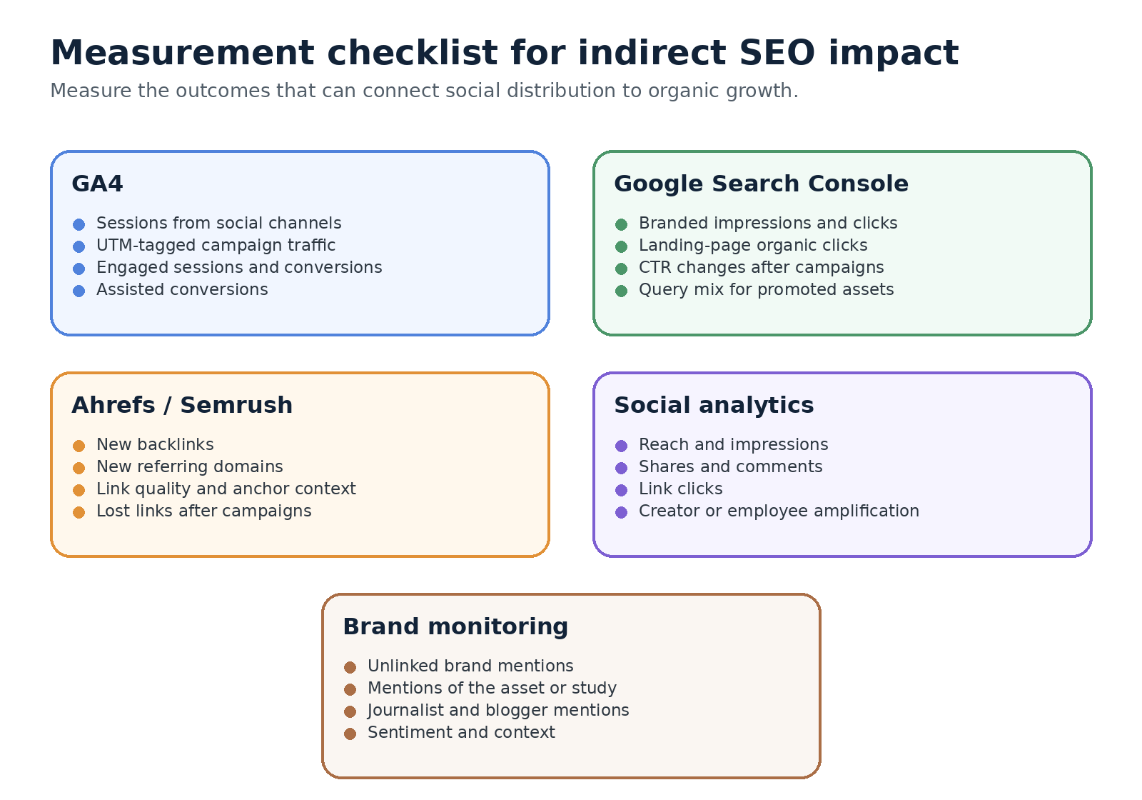
How to measure the SEO impact of social distribution
Measurement must start before promotion. Record the baseline for the target URL: organic clicks, ranking positions, referring domains, backlinks, branded impressions, social referrals, and conversions. Without a baseline, the team cannot separate campaign impact from normal search volatility.
Use UTM tags on social links. Split campaigns by platform, asset, message angle, and creator when possible. GA4 should show which social channel brought engaged sessions and conversions. Google Search Console should show whether branded searches or URL-level organic clicks changed after promotion.
Use Ahrefs or Semrush to track new backlinks and referring domains. Match link acquisition dates to social distribution dates. Check link context manually. A new referring domain matters more when the page cites the promoted asset as a source, not when the link appears in a scraped profile or spam page.
Use social analytics to evaluate reach and message fit. High reach with no referral sessions can mean the post kept attention on-platform. High clicks with no links can mean the content helped users but did not reach publishers. High mentions with no links creates a link reclamation task.
Use brand-monitoring tools to find unlinked mentions. Track the title of the asset, branded terms, author names, and unique statistics from the piece. Create a separate view for journalists, newsletter authors, bloggers, and community moderators.
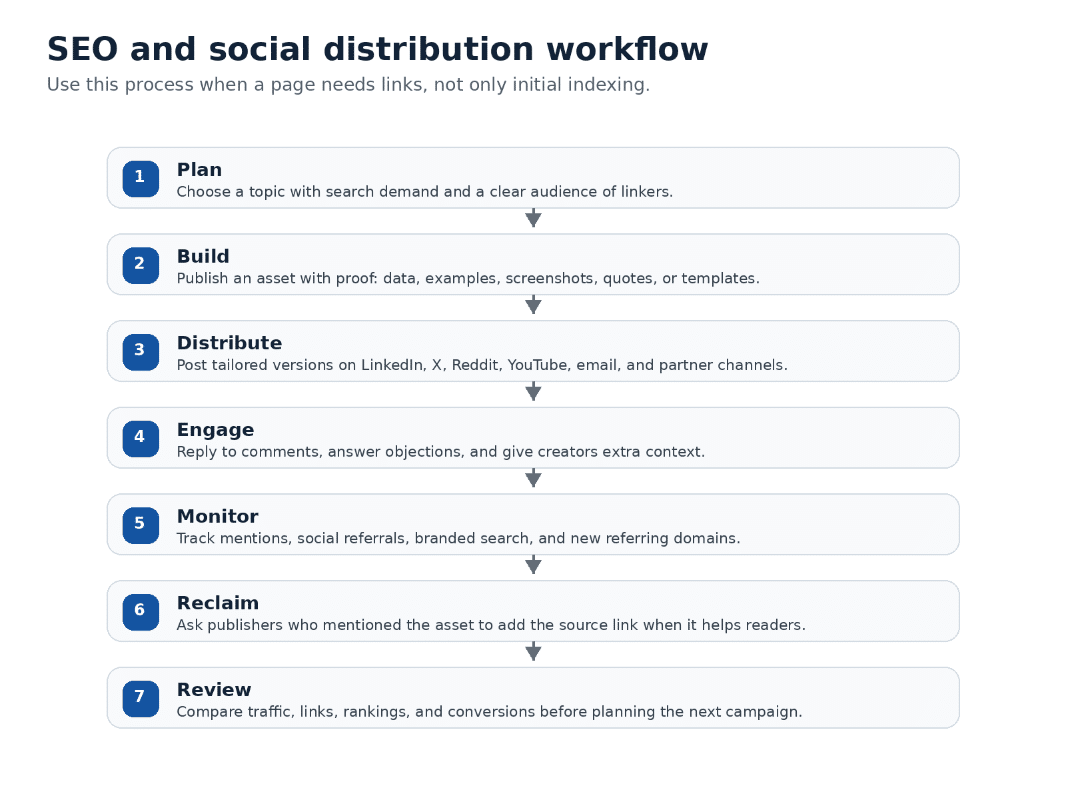
A practical workflow for SEO teams
The SEO team should own the search intent, target page, link goals, and measurement plan. The content team should own the asset. The social team should adapt the asset to each platform. PR or outreach should handle publisher relationships and link reclamation.
Before publication, the team should answer four questions. Who can link to this asset? What part of the asset deserves citation? Which social platform can reach those people? Which metric proves that distribution created SEO value?
After publication, the team should promote the asset in waves. The first wave goes to owned channels and employee accounts. The second wave goes to communities and partners. The third wave targets journalists, newsletter authors, and bloggers with the strongest reason to cite the asset.
After the campaign, the team should review outcomes. Separate distribution metrics from SEO metrics. Reach, likes, comments, and shares show whether the message traveled. Referral sessions, branded searches, mentions, and referring domains show whether the campaign created search-relevant assets.
Common reporting mistakes
The first mistake is reporting social engagement as SEO impact. A post with 1,000 likes can still produce no links, no branded search lift, and no organic growth. Treat likes as a distribution metric only.
The second mistake is ignoring unlinked mentions. A campaign can create real demand and still lose SEO value if no one monitors mentions and asks publishers to cite the source.
The third mistake is using the same content format on every platform. A LinkedIn carousel, an X thread, a Reddit answer, a YouTube short, and an email pitch need different hooks. The asset can stay the same. The packaging should change.
The fourth mistake is chasing platforms instead of audiences. A B2B SaaS benchmark may work on LinkedIn, newsletters, and analyst communities. A visual checklist may work on Pinterest or YouTube. A technical troubleshooting guide may work on Reddit and Stack-style communities. Match the platform to the people who can cite the content.
Final takeaways for SEO specialists
Social signals are not direct ranking factors. Google does not rank a page because the page received likes, shares, comments, or followers.
Social distribution can still support SEO. It can expose useful content to people who can mention, cite, or link to it.
Correlation studies do not prove that social engagement causes rankings. Useful content can cause both high engagement and strong search performance.
Social links usually carry little direct link equity. Treat them as traffic and discovery paths. Build the real SEO asset by earning independent editorial links.
Measurement must focus on outcomes. Track referral sessions, branded search, mentions, referring domains, link context, ranking changes, and assisted conversions.
The best social SEO program does not chase social signals. It publishes citable assets, distributes them to the right people, monitors mentions, converts relevant mentions into links, and reports only the outcomes that connect to organic growth.
Source note
This article was prepared from the attached research document, “Do Social Signals Help SEO? How Content Distribution, Mentions, and Backlinks Work Together.” The source research cites Google Search Central documentation, public statements from John Mueller, Matt Cutts, and Gary Illyes, and industry research or commentary from Ahrefs, Orbit Media, Rosemont Media, SparkToro, Searchmetrics-related analyses, Hootsuite-related analysis, and other SEO sources referenced in the research.
About the Author


I like that it clearly separates correlation from causation and focuses on the real SEO value of social distribution: getting content in front of people who can cite and link to it. A practical reminder that reach is just the first step—mentions and editorial backlinks are what matter